

You’re Following Fashion. But Do You Actually Have Style?
Fashion tells you what’s trending. Style tells the world who you are. Discover the real difference between fashion and personal style and how to make trends feel like you.
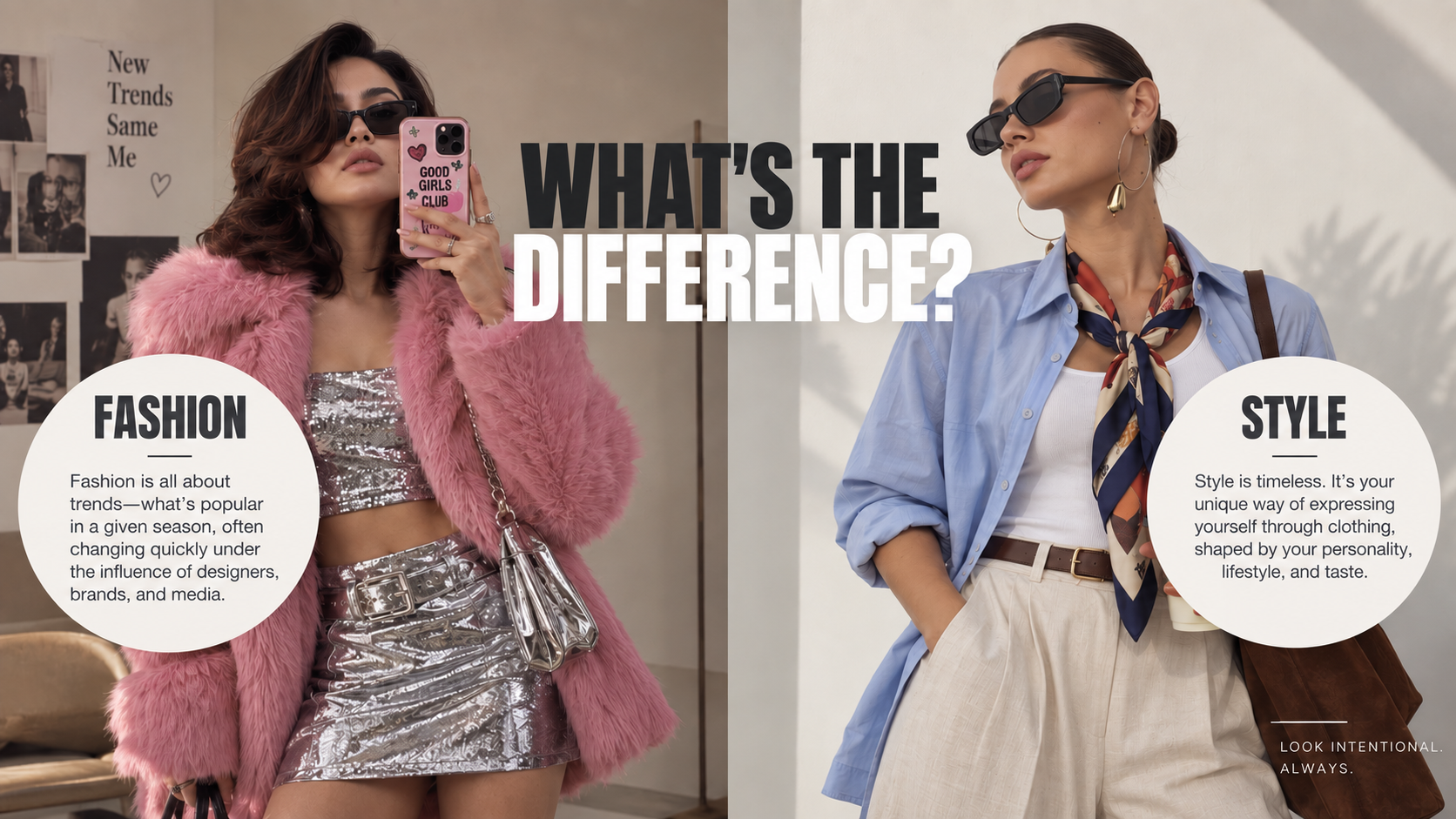
Fashion vs. Style: What’s the Difference and Why Does It Matter?
Fashion changes. Style stays.
One season, oversized silhouettes are everywhere. The next, fitted tailoring is back. One year, everyone is reaching for quiet neutrals; the next, bold colours are having a moment.
But here’s the interesting part: following fashion doesn’t automatically mean having great style.
Fashion tells you what’s happening. Style tells the world who you are.
So, what exactly is the difference between fashion and personal style? And more importantly, how do you make sure you’re not simply wearing trends, but actually wearing you?
What Is Fashion?
Fashion is the larger conversation happening around clothing and appearance.
It includes the trends, silhouettes, colours, designers, collections, aesthetics, and cultural influences that become popular at a particular point in time.
Think of fashion as a moving current. It is constantly changing, influenced by designers, celebrities, social media, street culture, films, music, and even what is happening in the world around us.
A trend might tell you that oversized shirts are in. Fashion gives you the idea.
But what you do with that idea is where style begins.
What Is Personal Style?
Personal style is your individual way of expressing yourself through what you wear.
It goes beyond simply choosing clothes you like. It is about the combination of your preferences, lifestyle, personality, comfort, proportions, colours, silhouettes, and the way you put everything together.
Two people can wear the exact same white shirt and look completely different.
One might pair it with tailored trousers and loafers. Another might wear it oversized with denim and sneakers.
Same fashion piece. Different style.
That is the beauty of personal style.
Fashion vs. Style: The Real Difference
The easiest way to think about it is this:
- Fashion is collective. Style is personal.
- Fashion changes with time. Style evolves with you.
- Fashion gives you options. Style helps you choose.
- Fashion asks, “What’s trending?” Style asks, “What feels like me?”
Fashion can inspire your wardrobe, but it shouldn't completely define it.
The most stylish people aren't necessarily the ones wearing every new trend. They are often the ones who know which trends belong in their wardrobe—and which ones don't.
Trendy Doesn't Always Mean Stylish
This is where many people get stuck.
You see an outfit online. You love it. You buy every piece. You recreate the look exactly.
And somehow, when you wear it, it doesn't feel right.
That doesn't mean the outfit was bad.
It simply means it wasn't necessarily your style.
A trend is designed to appeal to many people. Personal style is about discovering what works specifically for you.
The goal isn't to reject trends completely. It's to learn how to edit them.
Take a trend you love and ask:
- Does this silhouette work for me?
- Does this colour complement my wardrobe?
- Would I actually wear this in my everyday life?
- Can I style it in a way that feels natural to me?
If the answer is yes, make the trend yours.
If not, let it pass.
Style Is More Than Clothes
Personal style isn't just about the pieces hanging in your wardrobe.
It is also about how you wear them.
Your accessories, hairstyle, shoes, proportions, grooming, colour choices, and even the way you carry yourself can completely change the feeling of an outfit.
A simple outfit can look incredibly intentional when the details work together.
That is why two people wearing the same clothes can communicate completely different personalities.
Style lives in the details.
How to Start Finding Your Personal Style
You don't need to completely reinvent your wardrobe to discover your style.
Start by paying attention.
1. Look at What You Already Love
Open your wardrobe and identify the pieces you reach for again and again.
What do they have in common?
Maybe you prefer clean silhouettes. Maybe you always gravitate towards earthy colours. Maybe you love oversized layers or structured tailoring.
Your existing wardrobe can reveal more about your personal style than a Pinterest board ever could.
2. Collect Inspiration
Save outfits that immediately catch your attention.
Don't worry about naming your aesthetic at first.
Instead, look for patterns.
Do you keep saving monochrome outfits? Relaxed tailoring? Feminine silhouettes? Minimal accessories? Statement jewellery?
These patterns are clues.
3. Experiment
Style isn't something you discover by thinking about it forever.
You discover it by trying things.
Mix unexpected pieces. Try a different silhouette. Add a colour you normally avoid. Dress up something casual. Dress down something formal.
Some experiments will work.
Some absolutely won't.
That's part of finding your style.
4. Keep What Feels Like You
Not every trend deserves a place in your wardrobe.
And not every piece that looks amazing on someone else will work for you.
The best wardrobe is not necessarily the one with the most clothes. It's the one where more of your clothes feel like you.
The Sweet Spot: Fashion + Style
You don't have to choose between fashion and style.
In fact, the best personal style often comes from knowing how to use both.
Fashion can introduce you to something new.
Style decides whether you keep it.
Fashion can give you inspiration.
Style gives that inspiration your personality.
Fashion is the conversation.
Style is your voice.
So the next time you see a trend you love, don't just ask yourself, “Is this fashionable?”
Ask something better:
“How would I make this feel like me?”
Because the goal isn't to look like everyone else who is wearing the trend.
The goal is to make the trend look like you.
Ready to understand your personal style better?
The right styling isn't about changing who you are. It's about understanding what already makes you you—and learning how to express it through what you wear.